
The Best Fluffy Pancakes recipe you will fall in love with. Full of tips and tricks to help you make the best pancakes.

17 Minimalist Luxury Furniture Ideas That Elevate Every Room
The modern home has a clutter problem. For decades, the dominant approach to interior design has been additive: if a corner is empty, buy a plant; if a wall is bare, hang a shelf; if a room feels incomplete, add another accent chair. We have been conditioned to believe that a cozy, lived-in home must be filled to the brim with things.
But true luxury has undergone a quiet revolution. Today, the most sophisticated living spaces are not defined by what they contain, but by what they leave out. This is the core philosophy of “Fewer, Better Things.”
When you strip away the background noise of cheap, impulsive purchases and focus entirely on a few high-quality, beautifully designed essentials, something incredible happens. Your home stops feeling like a storage unit for your belongings and starts feeling like a sanctuary. It becomes a place of visual silence, physical comfort, and lasting beauty.
Here is a deep dive into the philosophy, the economics, and the practical application of choosing fewer, better things for your living space.
Looking to elevate more than just your furniture? These home coffee bar ideas will help you create a functional and luxurious space you’ll love.
The Psychology of Visual Noise
To understand why fewer things feel more luxurious, we have to look at how our brains process environments. Every object in your field of vision demands a tiny fraction of your cognitive energy.
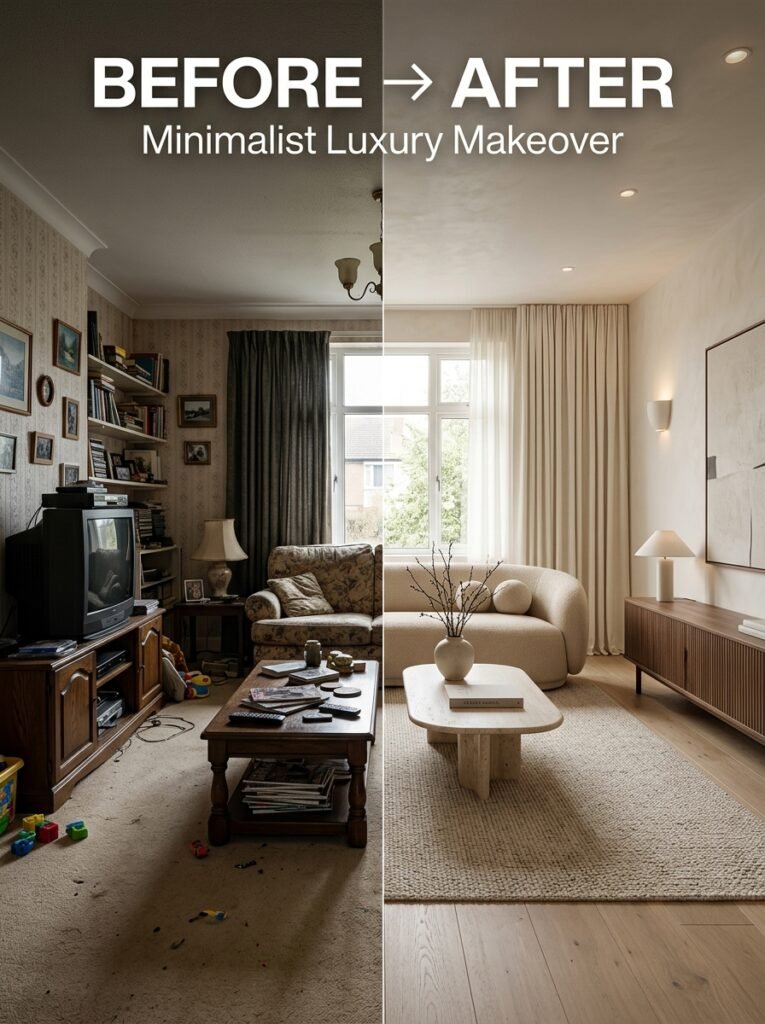
A cluttered room—filled with mismatched side tables, cheap plastic decor, tangles of power cords, and mass-produced chairs—creates what psychologists call visual noise. Even if you aren’t actively looking at the clutter, your brain is constantly scanning and processing it. This subtle, low-grade sensory overload makes it incredibly difficult to truly relax.
When you transition to a minimalist luxury setup, you are consciously creating negative space (the empty area around and between subjects). Negative space acts like a pause button for your eyes. It gives the brain a place to rest. By reducing the number of items in a room, you elevate the importance of the items that remain. A single, beautifully crafted oak chair in an empty corner is no longer just a place to sit; it becomes a piece of sculpture.
How to Spot “Better”: The Anatomy of High-Quality Furniture
“Better” is a subjective word, but in the world of luxury furniture, quality is highly objective. It is defined by engineering, materials, and craftsmanship. If you are going to invest a significant portion of your budget into just a few pieces of furniture, you must know how to separate genuine quality from high-priced marketing.
1. Frame Construction (The Skeleton)
The lifespan of any upholstered piece of furniture—like a sofa or an armchair—is determined entirely by its frame.
- The Cheap Standard: Most mass-market furniture is built using engineered wood, particleboard, or softwoods like pine, held together with staples, glue, and plastic corner brackets. Within a few years, these frames warp, squeak, and loosen.
- The Luxury Standard: High-end furniture utilizes kiln-dried hardwood (such as ash, maple, or oak). The kiln-drying process removes moisture from the wood, preventing it from warping or cracking over time. Furthermore, look for double-doweled joints and corner blocks secured with heavy-duty wood screws and glue.
2. The Suspension System (The Comfort)
What lies beneath the cushions determines whether your sofa will sag in two years or stay firm for twenty.
- The Cheap Standard: Simple drop-in pocket coils or zig-zag (sinuous) wires. These are cheap to manufacture but lose their tension quickly.
- The Luxury Standard: Look for eight-way hand-tied springs. This is the gold standard of furniture craftsmanship. A craftsman hand-ties high-carbon steel coil springs to one another and to the frame in eight different directions. This distributes weight incredibly evenly, offering unparalleled comfort and durability.
3. Material Honesty (The Surface)
True luxury materials are honest. They do not pretend to be something they are not. They are tactile, natural, and age gracefully.
Material Honesty (noun): The design principle of using materials in their most natural, unrefined state, allowing their inherent characteristics—like wood grains, stone veining, and fabric weave—to be the primary decorative element.
| Material | What to Avoid | What to Look For |
| Wood | MDF, plastic wood laminates, thin veneers over particleboard. | Solid timber (white oak, walnut, ash) with visible, natural grain. |
| Leather | Faux leather (polyurethane), bonded leather (shredded leather scraps glued together). | Full-aniline or semi-aniline leather that retains the natural hide characteristics and patinas beautifully. |
| Fabric | Highly synthetic polyester blends that pill, trap heat, and look shiny. | Natural linen, heavy cotton canvas, or Belgian wool with high textural depth. |
The “Hero Piece” Strategy
You do not need a massive budget to design a luxurious home. You simply need to allocate your budget differently. Instead of buying a complete, cheap furniture set, invest your resources into one outstanding piece per room—the “Hero Piece.”
The Living Room Hero: The Architectural Sofa
The sofa is the undisputed anchor of the living room. It dictates the entire mood of the space.
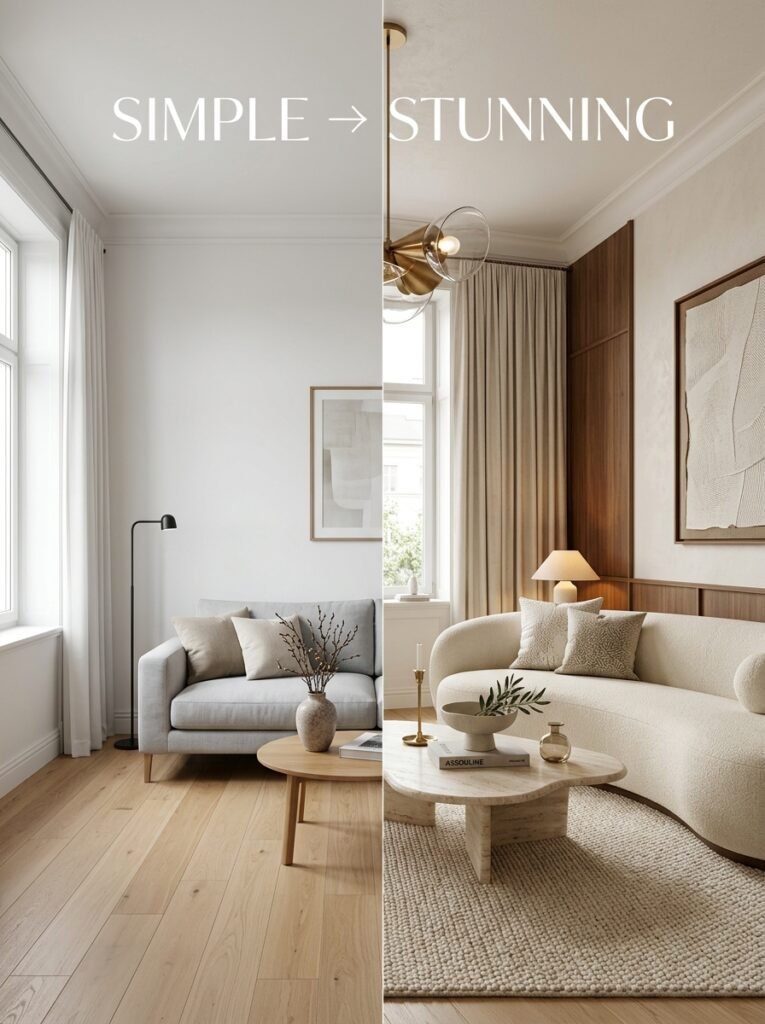
Instead of buying a standard three-seater sofa, a separate loveseat, and an armchair, buy one magnificent, deep-seated sectional. Look for a low-profile design that sits close to the ground; this keeps the sightlines of the room open and makes your ceilings feel higher. Choose a highly textured, durable fabric like a heavy Belgian linen or a nubby bouclé. When your sofa is exceptionally comfortable and beautiful, you do not need accent tables, extra chairs, or decorative throws to make the room feel complete.
The Dining Room Hero: The Monolithic Table
The dining table is more than just a place to eat; it is a gathering ground.
Instead of a glass-topped or veneered table that shows every fingerprint and scratch, save your budget for a solid wood table. A thick, minimalist slab of oak or walnut with simple, structural legs acts as a natural masterpiece. The beauty of solid wood is that it is living history; every scratch, ding, and spill from family dinners over the years simply adds to its character. If it ever gets too worn, you can simply sand it down and refinish it—it is a piece designed to be passed down through generations.
The Bedroom Hero: The Grounding Bed Frame
The bedroom should be a temple of quietness.
Remove the bulky dressers, the matching nightstands, and the plastic storage bins. Your hero piece here is a low-slung, upholstered platform bed. A bed frame wrapped in soft, tactile fabric (like a wool blend or heavy canvas) instantly softens the acoustics of the room, making it feel quieter and more peaceful. Pair it with two simple, floating wooden shelves as nightstands to keep the floor completely clear.
The Economics of Minimalist Luxury
At first glance, buying luxury furniture can seem incredibly expensive. However, when you calculate the Cost-Per-Year rather than the upfront price, buying fewer, better things is actually the more financially intelligent decision.
Let’s look at the math over a fifteen-year period:
Scenario A: The Disposable Furniture Cycle
You buy a cheap, mass-manufactured sofa for $800.
- Year 2: The cushions begin to sag, and the fabric starts pilling.
- Year 4: The internal frame begins to creak, and one of the springs loses tension. You throw it away.
- Year 5: You buy another trend-focused sofa for $1,000.
- Year 9: This one also breaks down. You replace it for $1,200.
- Year 13: You replace it again for $1,500.
- Total Spent over 15 Years: $4,500 (plus the immense hassle of moving, disposing of, and assembling four different sofas).
Scenario B: The Investment Strategy
You buy a high-end, hand-built, heirloom-quality sofa for $3,500.
- Year 5: The sofa feels exactly the same as the day you bought it. The natural linen has softened beautifully.
- Year 10: It remains incredibly supportive and structurally flawless.
- Year 15: The frame is still perfect. If the fabric has finally worn down after a decade and a half of heavy use, you spend $1,000 to have it professionally reupholstered, essentially getting a brand-new sofa for a fraction of the cost.
- Total Spent over 15 Years: $3,500 (for an item that brought you joy, comfort, and pride every single day).
By breaking the cycle of disposable consumerism, you save money, reduce environmental waste, and live in a significantly more beautiful environment.
A Practical Guide to Transitioning Your Space
Transitioning to a “fewer, better things” lifestyle does not happen overnight. It is a slow, intentional process of editing your home. Here is a step-by-step roadmap to guide you:
Step 1: The “Visual Audit”
Go into your main living space and sit down. Close your eyes for thirty seconds, then open them. Note the very first things your eyes land on.
Are they landing on beautiful, intentional items, or are they landing on clutter? Take a box and remove every single decorative item that does not serve a daily functional purpose or bring you genuine artistic joy. Put them in a closet for two weeks. You will be amazed at how much lighter and more peaceful the room feels almost instantly.
Step 2: Focus on the Floor
One of the easiest ways to create an upscale, minimalist look is to maximize visible floor space. Look at your current furniture. How many items sit flat on the floor, blocking your view?
When replacing items, look for furniture with raised legs. A sideboard, media console, or sofa elevated even just six inches off the ground allows light to flow underneath, immediately making the entire room feel larger and less crowded.
Step 3: Embrace the “One-In, Two-Out” Rule
As you begin to curate your home, make a pact with yourself: for every new piece of furniture or decor you bring into your house, you must sell, donate, or recycle two existing items. This forces you to be incredibly selective about what you buy. If a new item isn’t good enough to make you want to part with two old items, it doesn’t deserve a place in your home.
The Ultimate Luxury is Peace of Mind
Minimalist luxury is not about living in an empty, sterile museum. It is about reclaiming your space, your time, and your attention.
When you choose to live with fewer, better things, you stop spending your weekends dusting useless knick-knacks, cleaning crowded rooms, and shopping for cheap replacements. Instead, you get to sit back, relax, and enjoy a home that feels incredibly spacious, beautifully organized, and uniquely yours.